

OFF CAMPUS FEELS LIKE A CULTURAL RESET
For a generation raised on grand gestures disguised as love, blurred boundaries, and the idea that chaos equals chemistry, Off Campus feels almost revolutionary. Not because it invents something entirely new, but because it quietly corrects what so many of us were taught to accept.
It doesn’t just show romance. It shows relationship literacy — something many of us were never formally taught, but learned through trial, error, heartbreak, and repetition.
And that’s where its impact sits: not in fantasy, but in recognition.
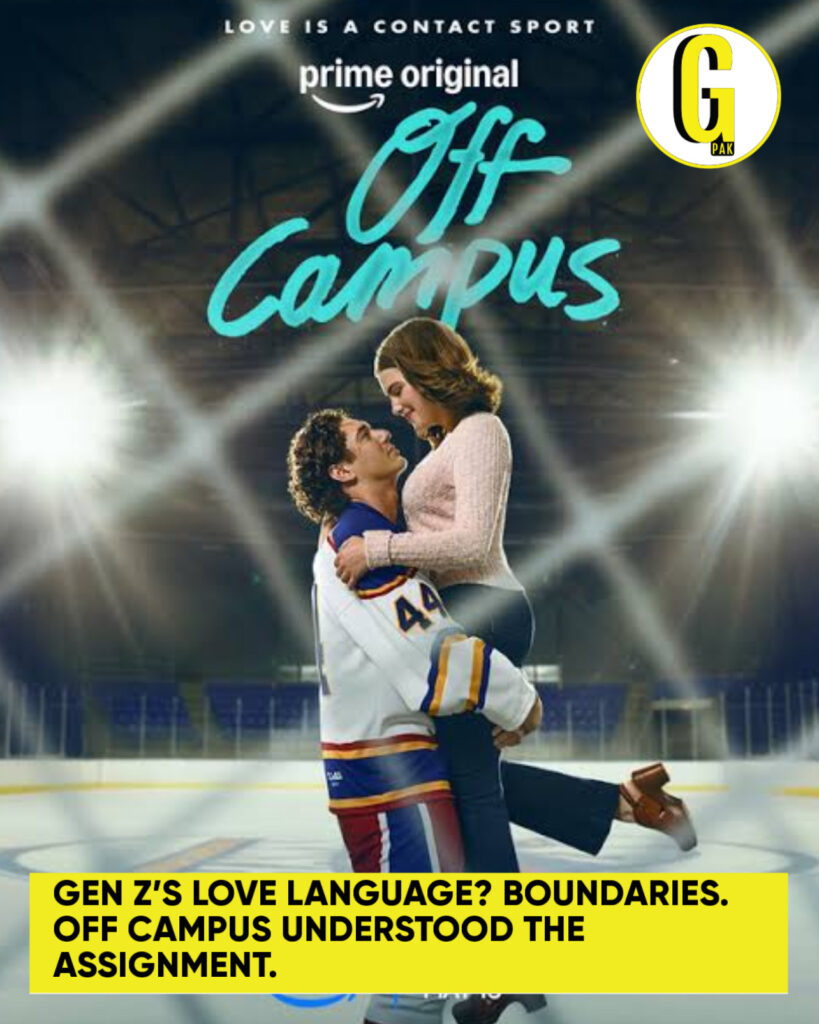
THE ROMANCE WE WERE RAISED ON VS THE ROMANCE WE NOW QUESTION
There was a time when love stories were built on tension that often blurred into dysfunction. Jealousy was framed as passion. Emotional inconsistency was framed as depth. Pain was reframed as proof that something was “real.”
Many millennials grew up internalising this without even realising it. The narrative was subtle but persistent:
- If it hurts, it must mean it matters
- If he is unpredictable, he must be intense
- If you have to earn love, you are worth more when you succeed
So when we met stories like Off Campus, something shifted.
Not loudly. Not dramatically. But noticeably.
Because suddenly, love wasn’t being measured by how much you could endure — but by how well you could communicate.

WHAT
OFF CAMPUS DOES DIFFERENTLY
At its core, Off Campus offers something deceptively simple: emotionally functional relationships.
That means:
- Conflict that leads to conversation, not punishment
- Attraction that doesn’t rely on humiliation or games
- Friendship that exists without competition or insecurity
- Love that allows both people to remain whole individuals
The characters don’t just fall in love. They learn how to stay in love — and that distinction is everything.
There is accountability. There is apology. There is clarity where older narratives would have created silence.
And for many readers, that is unfamiliar in the most grounding way possible.
Because it replaces chaos with something quieter:
emotional safety.
WHY GEN Z IS RESPONDING SO STRONGLY
Gen Z is often described as “boundary-aware,” but that doesn’t fully capture it. It’s not just awareness — it’s intolerance for emotional ambiguity that costs selfhood.
This generation is asking questions earlier, and more directly:
- Does this feel safe for me?
- Do I shrink in this relationship, or expand?
- Is love being proven through words, or through consistency?
So when they encounter Off Campus, they don’t just see romance. They see a model of what relationships can look like when ego is not the main character.
There is a cultural shift here — away from romanticising emotional volatility, and toward valuing emotional clarity.
And that shift changes what we consider attractive.

WHAT THIS SHOW DOES FOR MILLENNIALS TOO
But the impact is not limited to Gen Z.
For many millennials, Off Campus lands like a quiet form of emotional repair.
It reopens memories of what we were taught love should look like — and gently, almost imperceptibly, offers an alternative.
We were raised on narratives where:
- Being chosen mattered more than being respected
- Fixing someone was framed as devotion
- Endurance was romanticised as loyalty
- Inconsistency was mistaken for depth
So when we watch relationships built on communication instead of confusion, something subtle happens: we begin to question what we once accepted as normal.
And that questioning can feel surprisingly emotional.
Because it doesn’t just challenge fictional relationships.
It challenges memory.
It challenges conditioning.
It challenges the version of love we once thought we had to accept in order to be loved at all.
In that sense, Off Campus doesn’t just entertain — it reframes.
WHY HEALTHY LOVE STILL FEELS “NEW”
One of the most interesting cultural shifts happening right now is that healthy love still feels unfamiliar in fiction.
Not because it is rare in reality, but because it was historically considered “boring” in storytelling.
We were trained to equate:
- chaos with chemistry
- emotional distance with desire
- instability with intensity
So when we see relationships that are steady, communicative, and respectful, our first instinct is often to underestimate them.
But Off Campus challenges that bias.
It shows that:
- consistency can be magnetic
- kindness can be intimate
- respect can be deeply attractive
- safety does not cancel passion
It repositions what we consider “romantic enough.”
THE REAL REASON IT STAYS WITH US
The reason stories like Off Campus linger is not because of the romance itself, but because of what it quietly removes.
It removes the idea that love must hurt to be real.
It removes the belief that emotional exhaustion is normal in relationships.
It removes the glamour from dysfunction.
And what it leaves behind is deceptively simple:
two people choosing each other without abandoning themselves.
That is not just a storyline. It is a recalibration.
FINAL THOUGHT
Maybe the real cultural shift isn’t that Gen Z wants different love stories.
Maybe it’s that they are no longer willing to confuse instability for intensity.
And maybe millennials, in watching these stories too, are not just consuming fiction — but gently rewriting their internal definitions of love, one scene at a time.
Because at its core, Off Campus is not just about romance.
It is about learning that love, at its healthiest, is not something you survive.
It is something that lets you breathe.
